
How to Get a Better Grade in ESCAPE CLUB | Escape Rooms
Your end-of-run Rank grades the escape on speed — faster clears mean a better letter grade. See what the ESCAPED screen shows and how to escape faster.
Quick answer
Your Rank is the letter grade ESCAPE CLUB | Escape Rooms gives your group after a successful escape, and it is graded on speed. The developer's own summary says it directly: Faster = better grade. The less time you use — the same thing as more time left on the clock when you escape — the higher your Rank.
- Every case is a timed room: CASE 01 and CASE 02 give 25 minutes, CASE 03 gives 30.
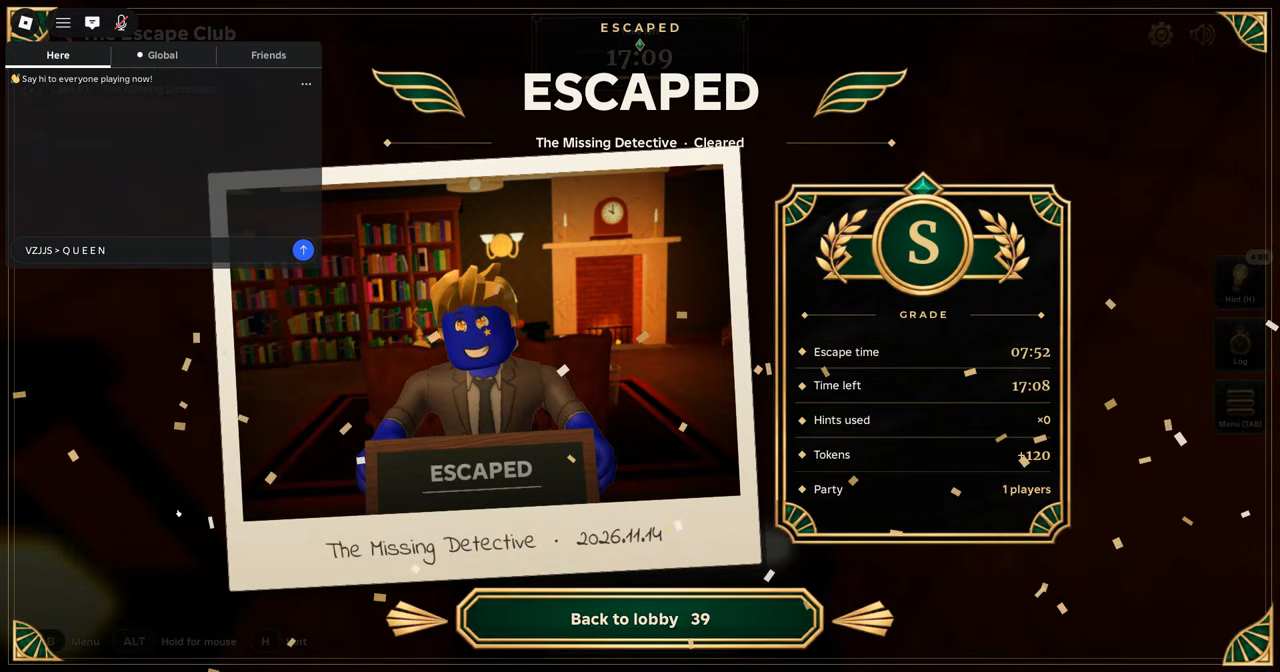
- The ESCAPED results screen shows your grade, Escape time, Time left, Hints used, Tokens earned and party size.
- Speed pays twice: a faster escape earns a better grade and more Tokens for cosmetic trails and titles.
How the end-of-run Rank works
Every room in ESCAPE CLUB | Escape Rooms runs on a timer. You form a party in the hotel lobby, ride the elevator, get locked in, and have to find clues and crack the locks before time runs out. When you make it out, the game grades the run with a letter Rank, and that grade is based on how quickly your group finished. The developer describes the rule as "Faster = better grade", and a guide to the game explains it the same way: less time used means a higher rank — or put the other way around, the game grades your run based on how much time you had left at the moment of escape.
The practical consequence is simple: solving the puzzles is what lets you escape at all, and how much of the room's clock is still running when you do decides the grade. Nothing substitutes for finishing quickly.
What the ESCAPED screen shows
Clearing a room ends on an ESCAPED results screen, which lays out exactly the numbers the grading is built from:
- The room name with Cleared — for example, "The Missing Detective · Cleared"
- A letter grade
- Escape time — how long the run took
- Time left — what remained of the room's limit
- Hints used
- Tokens earned
- Party size
One observed solo run shows how these fit together. In CASE 01 · The Missing Detective — a 25-minute room — the player escaped in 07:52, leaving 17:08 on the clock, finished with Hints used x0, and the screen reported an S grade with Tokens +120 for a party of 1. Escape time plus time left adds up to the room's full limit, so you can read your own margin directly off this screen: the bigger the Time left number, the better the speed side of your run went.

Why a better grade is worth chasing
A Rank is not the only thing speed buys. Escaping a room earns Tokens, the reward currency used to buy cosmetic trails and titles for your character. The observed S-grade run above paid out Tokens +120 — one specific solo clear, so treat the exact figure as an example rather than a fixed payout. The game's guide sums up the whole loop in one line: escaping faster earns a higher rank and more tokens, which you spend on cosmetics. If you are working toward a particular trail or title, shaving minutes off your clears is the supported way to earn more per run. See how to get and use Tokens for what they buy.
How to escape faster
First, know the clock you are playing against:
| Case | Theme | Time limit |
|---|---|---|
| CASE 01 · The Missing Detective | Mystery | 25 min |
| CASE 02 · Station Omega | Sci-Fi | 25 min |
| CASE 03 · Ward 404 | Horror | 30 min |
Beyond the raw limit, the run itself is filled with the puzzle objects that eat time: keys, locks, safe dials, keypads, UV ink, Morse code, lasers and wiring. Two habits follow directly from how the game works:
- Learn the controls until they are automatic. Rooms are worked with E to interact, the 1–8 item inventory, the TAB menu, ALT for the mouse and H for a hint. Every second spent hunting for the right key is a second subtracted from Time left on the results screen. The controls guide covers these in detail.
- Handle special puzzle items correctly the first time. UV ink, for instance, is hidden writing that only appears when you use the correct special item on it — trying the wrong tool costs clock time for nothing. The puzzle mechanics guide goes deeper into these objects.
What about hints?
Hints are available anytime during a room — press H. Because the grade is tied to time, the cost of a hint decision is measured in the seconds you spend deliberating as much as in the hint itself; one S-grade run finished with Hints used x0. What the available evidence does not establish is whether hints directly lower the grade — the confirmed relationship runs through time. So the safe read is: a hint that unblocks you immediately can be faster than minutes of stuck guessing, while sitting on a decision about whether to take one only burns clock. If you want the mechanics of the hint system itself, see how to use hints.
Going in prepared
If you would rather know the solutions before the elevator doors close, all cases and rooms gives an overview of every case, and individual walkthroughs — The Missing Detective, Station Omega and Ward 404 — cover each one step by step. New to the game entirely? The beginner guide starts from the hotel lobby.
Related Guides
How to Get and Use Tokens
How escaping cases earns tokens — faster escapes pay more — and what they buy: trails and titles.
Puzzle Mechanics Guide
Every lock type in the game and how to read the clues in your own room instead of copying answers.
Titles: What They Are and How to Get One
Titles are cosmetic labels bought with the tokens earned from fast escapes.